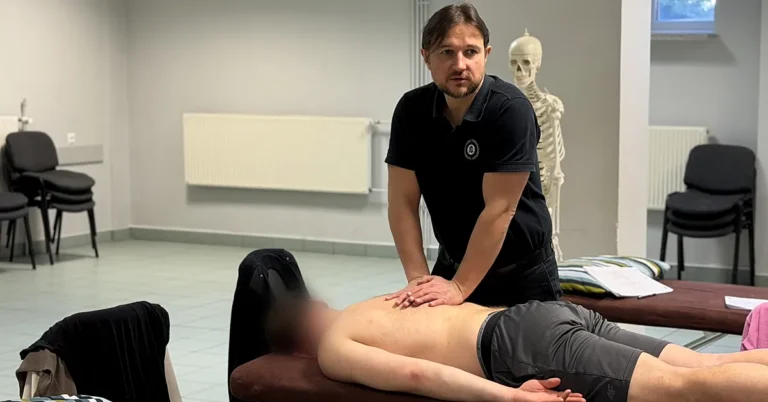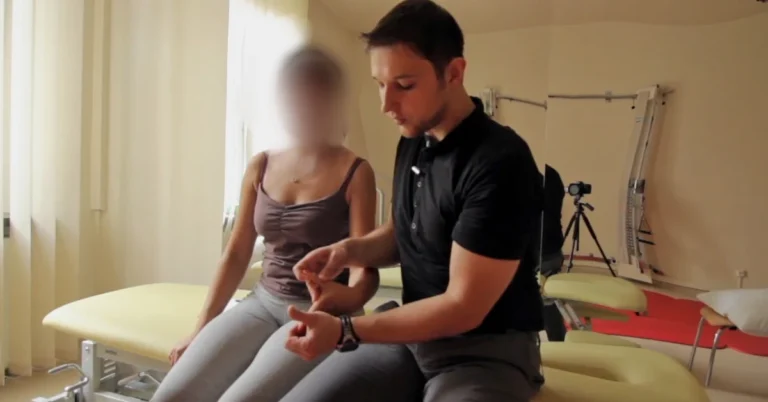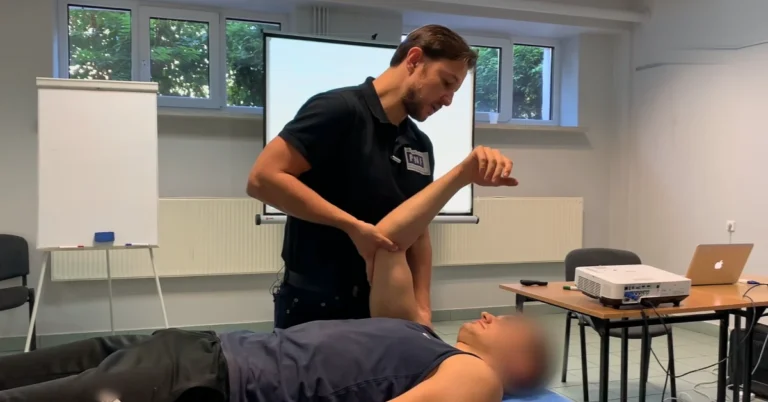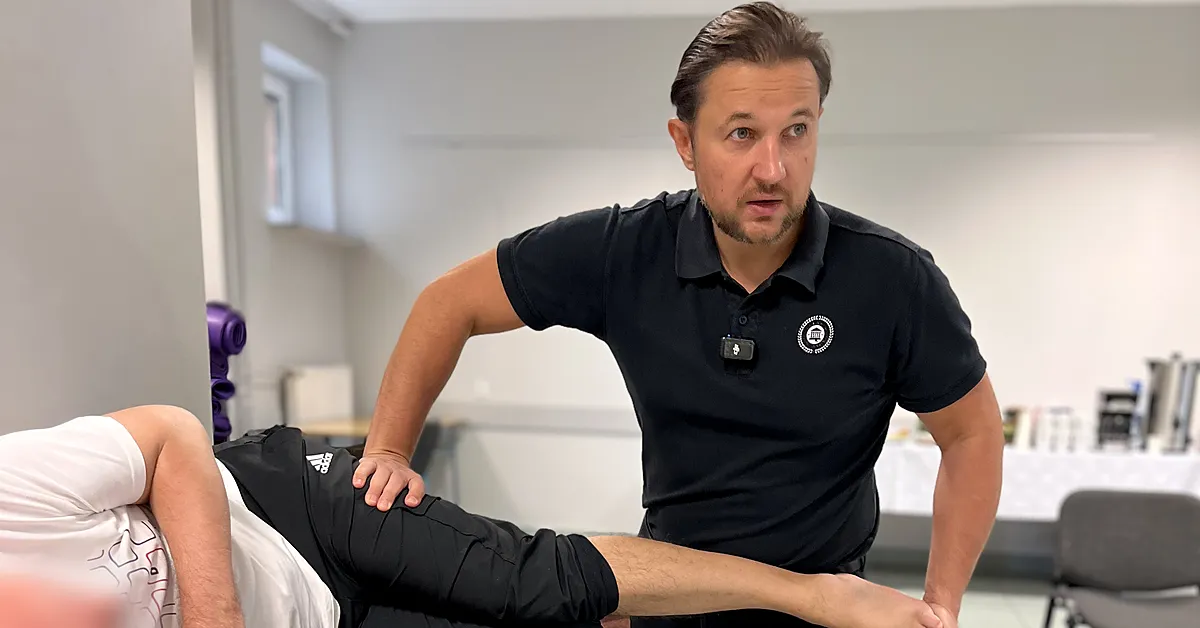
PNF techniques turn an exercise into targeted treatment. The same movement can be trained in several ways. For example, the patient can use concentric, static or eccentric contractions, work in one direction or in both, and relax between contractions or not. The technique decides how the patient works, and therefore which goal the exercise serves.
This guide describes the ten PNF techniques of the International PNF Association. For each technique, you will find the goals, the indications and, where they apply, the contraindications. The descriptions follow the textbook by Beckers and Buck [1].
What is a PNF technique?
Beckers and Buck define a PNF technique as a sequenced method of facilitation. It aims to improve body functions or activities within the context of a treatment goal [1]. To do this, the techniques combine concentric, eccentric and static muscle contractions with graded resistance and suitable facilitation procedures [1]. The therapist then adjusts this combination to the needs of each patient.
The techniques are one of the three pillars of the PNF concept. The other two are the PNF philosophy and the basic principles and procedures [2]. In other words, PNF is much more than stretching. Many reviews have focused mainly on “PNF stretching”. As Smedes points out, this has been criticized because it confuses one use of PNF with the concept as a whole [2]. In fact, only two of the ten PNF techniques are relaxation techniques [1].
How the PNF techniques are grouped
The International PNF Association classifies the techniques by the type of active muscle work [1]:
| Group | PNF techniques | Muscle activity |
|---|---|---|
| Agonistic techniques | Rhythmic initiation, repeated stretch from beginning of range, repeated stretch through range, combination of isotonics, replication | Contractions and movements in the targeted direction |
| Antagonistic techniques | Dynamic reversals, stabilizing reversals, rhythmic stabilization | Alternating contractions or co-contraction of agonists and antagonists |
| Relaxation techniques | Hold-relax, contract-relax | A voluntary contraction followed by voluntary relaxation |
The muscle activity column follows Smedes [2]. Note that older publications may use other names. The current names were agreed by consensus among the members of the International PNF Association [2]. For example, repeated stretch through range was formerly called repeated contractions [1].
Agonistic PNF techniques
Rhythmic initiation
Rhythmic initiation is a rhythmic, unidirectional motion of the limb or body through the desired range. It starts with passive motion and progresses to active resisted movement [1]. The technique has four stages [1]:
- Passive: the therapist moves the patient through the range. The speed of the verbal command sets the rhythm.
- Active assisted: the patient starts to help in the desired direction, while the therapist does the return motion.
- Resisted: the therapist resists the active movement and keeps the rhythm with the verbal commands.
- Independent: the patient makes the motion alone.
During the passive stage, the therapist explains the goal of the movement with verbal, visual or tactile input. As a result, the patient takes a cognitively active role even when the movement is passive [1].
- Goals: aid the initiation of motion, improve coordination and the sense of motion, normalize the rate of motion, teach the motion and help the patient to relax [1].
- Indications: difficulty initiating motion, movement that is too slow or too fast, uncoordinated or dysrhythmic motion (as in ataxia and rigidity), and the need to regulate muscle tone or general tension [1].
Repeated stretch from beginning of range
This technique uses the stretch reflex repeatedly to elicit active recruitment from muscles under the tension of elongation [1]. Only the muscles should be under tension, so take care not to stretch the joint structures [1].
First, the therapist fully elongates the muscles of the pattern, with particular attention to rotation. Next, the therapist gives a preparatory command and a quick tap to evoke the stretch reflex. At the same time, the command asks for a voluntary contraction. Then the therapist resists both the reflex and the voluntary response [1]. The stretch can be repeated from the beginning of the range as soon as the contraction weakens [1].
- Goals: facilitate the initiation of motion, increase the active range of motion and strength, prevent or reduce fatigue and guide the motion in the desired direction [1].
- Indications: weakness, inability to initiate motion because of weakness or rigidity, fatigue and decreased awareness of motion [1].
Repeated stretch through range
Here the stretch reflex comes from muscles under the tension of contraction [1]. In practice, the therapist resists a pattern so that all its muscles are contracting. Then the therapist slightly over-resists the motion to elongate the muscles a little. The patient must not relax or reverse direction. Instead, a command asks for a new and stronger contraction, which the therapist resists [1].
Always allow the patient to move before the next re-stretch. As a rule of thumb, Beckers and Buck give three to four re-stretches during one pattern [1].
- Goals: increase the active range of motion and strength, prevent or reduce fatigue, guide the motion and normalize muscle tone [1].
- Indications: weakness, fatigue and decreased awareness of the desired motion [1].
Clinical tip
Both stretch techniques share the same contraindications: joint instability, pain, unstable bones due to fracture or osteoporosis, and damaged muscle or tendon [1].
Combination of isotonics
Gregg Johnson and Vicky Saliba described this technique [1]. It combines concentric, eccentric and stabilizing contractions of one group of muscles, the agonists, without relaxation [1]. For example, the therapist resists a concentric movement through the range. At the end, the patient holds the position. When the position is stable, the patient allows the body part to move slowly back to the start with an eccentric contraction [1]. Throughout, the therapist’s hands stay on the same surface.
Start where the patient has the most strength or the best coordination [1]. The stabilizing or eccentric contraction may also come first. Moreover, one type of contraction can change to another before the full range is completed [1].
- Goals: active control of motion, coordination, a larger active range of motion, strength and functional training of eccentric control [1].
- Indications: decreased eccentric control, lack of coordination or of the ability to move in a desired direction, decreased active range of motion, and lack of active motion within the available range [1].
Clinical tip
In our practice, combination of isotonics is the technique of choice. Our goal is to restore eccentric control of the patient’s individual joints, because we see it as the foundation of controlling the body in space. The technique combines what is easier for the patient, static and concentric work, and in this way prepares eccentric control. In many cases, it helps to build the foundation of motor control.
Replication
Replication facilitates motor learning of functional activities. Specifically, it teaches the patient the end position, or outcome, of a movement [1].
The therapist places the patient in the end position of the activity and resists the patient’s effort to hold it. Then the patient relaxes, and the therapist moves the patient passively a short distance back. Next, the patient returns to the end position. With each repetition, the start moves farther from the end position. In the end, the patient performs the activity alone, without facilitation or manual contact [1]. Beckers and Buck note that replication is useful for ataxia and coordination problems [1].
Antagonistic PNF techniques
The antagonistic, or reversal, techniques are based on Sherrington’s principles of successive induction and reciprocal innervation [1].
Dynamic reversals
Dynamic reversals are active resisted concentric movements. They change from one direction, the agonist, to the opposite direction, the antagonist, without pause or relaxation [1]. In daily life, we see this kind of muscle activity when we throw a ball, cycle or walk [1].
The therapist usually resists the stronger direction first. Near the end of the range, the therapist changes one grip and gives a preparatory command. Then the action command reverses the direction, and the resistance to the new motion starts distally. Finally, the therapist changes the second grip [1]. Use the stretch reflex only at the start, because the antagonists are not yet under tension when the direction changes. Also, resist the change of direction rather than assist it [1].
The change of direction does not have to happen at the end of the range. On the contrary, it can be used to emphasize a particular part of the range [1]. Furthermore, a reversal can be made whenever the agonists begin to fatigue [1].
- Goals: increase the active range of motion, strength and endurance, develop coordination, prevent or reduce fatigue and decrease muscle tone [1].
- Indications: decreased active range of motion, weakness of the agonists, decreased ability to change direction, fatigue, and relaxation of hypertonic muscle groups [1].
Stabilizing reversals
Stabilizing reversals are alternating isotonic contractions, opposed by enough resistance to prevent motion [1]. The therapist gives a dynamic command, such as asking the patient not to let the therapist push them. Only a very small movement is allowed [1].
The therapist starts in the strongest direction and can add approximation or traction to increase stability. When the patient fully resists, the therapist moves one hand to resist another direction. After the patient responds, the other hand follows [1]. The resistance can also move around the body, for example from the upper trunk to the pelvis and then to the neck [1].
- Goals: better stability and balance, more strength and better coordination between agonists and antagonists [1].
- Indications: decreased stability, weakness, and a patient who cannot contract isometrically and still needs resistance in one direction [1].
Rhythmic stabilization
Rhythmic stabilization uses alternating isometric contractions against resistance, and no motion is intended [1]. Therefore, the therapist gives a static command, such as “stay there” or “don’t try to move” [1].
The therapist resists an isometric contraction of the agonists and increases the resistance slowly as the patient builds a matching force. Then the therapist slowly changes the resistance so that the antagonists work. Neither the therapist nor the patient relaxes during the change [1]. The technique should begin with the stronger muscle group to facilitate the weaker one [1].
- Goals: increase the active and passive range of motion, increase strength, improve stability and balance, and decrease pain [1].
- Indications: limited range of motion, pain (particularly when motion is attempted), joint instability, weakness of the antagonistic muscle group and decreased balance [1].
- Contraindications: cerebellar involvement, where the technique may be too difficult, as Kabat noted; and inability to follow instructions because of age, language difficulty or cerebral dysfunction [1].
Stabilizing reversals or rhythmic stabilization?
The two techniques are easy to confuse. Beckers and Buck summarize the differences as follows [1]:
| Feature | Stabilizing reversals | Rhythmic stabilization |
|---|---|---|
| Muscle action | Isotonic | Isometric co-contraction, no movement allowed |
| Intention to move | Yes | No |
| Command | Dynamic | Static |
| Hand grip | Changes with each change of direction | May grip on both sides and change the direction of resistance slowly |
| Muscle activity | From agonist to antagonist and back | Agonists and antagonists together |
| Suitable patient | Can control only one direction at a time | Can control both directions together |
Relaxation techniques in PNF
In these techniques, Beckers and Buck call the restricting, shortened muscles the antagonists [1].
Hold-relax
Hold-relax is a resisted isometric contraction of the shortened muscles, followed by relaxation [1]. The therapist or the patient moves the body part to the end of the passive or pain-free range. Then the therapist asks for an isometric contraction of the restricting muscles, with emphasis on rotation. The resistance increases slowly, and no motion is intended. The authors suggest holding the contraction for at least 5 to 8 seconds [1]. After that, the therapist and the patient relax gradually. Finally, the body part moves to the new limit of the range, preferably actively, and the steps are repeated [1].
- Goals: increase the passive range of motion and decrease pain [1].
- Indications: decreased passive range of motion, pain, a patient who does not tolerate direct control, and isotonic contractions that are too strong for the therapist to control [1].
- Contraindication: inability to perform an isometric contraction [1].
When contraction of the shortened or painful muscles hurts, use the indirect method. In that case, the therapist resists the synergists distant from the painful segment and keeps the resistance below the level that causes pain [1].
Contract-relax
Contract-relax is a resisted isotonic, or more static, contraction of the restricting muscles. It is followed by relaxation and movement into the new range [1]. The therapist asks for a strong contraction of the restricting pattern at the end of the passive range. Again, the authors suggest holding it for at least 5 to 8 seconds [1]. A minimal motion is allowed, so that the therapist can feel that all the muscles, particularly the rotators, are contracting. After the relaxation, the patient moves into the new range, and the technique is repeated until no more range is gained [1].
The goal is to increase the passive range of motion [1]. Afterwards, active resisted exercise of the agonists and antagonists in the new range finishes the technique [1]. If contraction of the restricting muscles is too painful or too weak, the indirect method uses a contraction of the agonists instead [1].
In short, Beckers and Buck use hold-relax for painful conditions, with a slow, soft command and no intention to move. By contrast, they use contract-relax when there is no pain and the therapist has good control, with a strong command [1].
How do the relaxation techniques work?
The mechanism is still debated. Traditionally, the gains in range of motion were attributed to autogenic or reciprocal inhibition. However, a review by Sharman and colleagues found that the literature does not support this explanation [3]. Instead, the contemporary view is that these techniques change the point at which stretch is perceived or tolerated [3]. Similarly, Hindle and colleagues identified four proposed mechanisms: autogenic inhibition, reciprocal inhibition, stress relaxation and the gate control theory of pain. They concluded that a combination of these mechanisms is plausible, but needs more research [4].
Keep in mind that this research comes mainly from “PNF stretching” studies. For instance, Sharman and colleagues conclude that a static contraction of the target muscle should last about 3 seconds. Its strength should be no more than 20% of a maximal voluntary contraction [3]. This differs from the 5 to 8 seconds that Beckers and Buck suggest [1,3].
How to choose a PNF technique
Choose the technique for the impairment that disturbs a functional activity. To do so, analyze the task and the muscle coordination it requires [2]. Smedes gives two examples [2]. Placing a book on a shelf needs a concentric contraction to lift the arm and an eccentric contraction of the same muscles to lower it. So this task suits combination of isotonics. On the other hand, pulling a rope to open a sunshade needs the antagonists to work concentrically after the reach. Therefore, this task suits dynamic reversals.
PNF techniques by treatment goal
Beckers and Buck also list PNF techniques by treatment goal [1]:
| Goal | PNF techniques |
|---|---|
| Initiate motion | Rhythmic initiation, repeated stretch from beginning of range |
| Learn a motion | Rhythmic initiation, combination of isotonics, both repeated stretch techniques, replication |
| Change the rate of motion | Rhythmic initiation, dynamic reversals, both repeated stretch techniques |
| Increase strength | Combination of isotonics, dynamic reversals, rhythmic stabilization, stabilizing reversals, both repeated stretch techniques |
| Increase stability | Combination of isotonics, stabilizing reversals, rhythmic stabilization |
| Increase coordination and control | Combination of isotonics, rhythmic initiation, dynamic reversals, stabilizing reversals, rhythmic stabilization, repeated stretch from beginning of range, replication |
| Increase endurance | Dynamic reversals, stabilizing reversals, rhythmic stabilization, both repeated stretch techniques |
| Increase range of motion | Dynamic reversals, stabilizing reversals, rhythmic stabilization, repeated stretch from beginning of range, contract-relax, hold-relax |
| Relaxation | Rhythmic initiation, rhythmic stabilization, hold-relax |
| Decrease pain | Rhythmic stabilization or stabilizing reversals, hold-relax |
Combining PNF techniques
Finally, the techniques can be combined. For example, contract-relax can increase the range of motion. Then dynamic reversals or combination of isotonics can build strength and control in the newly gained range [1]. Likewise, after a strengthening technique such as repeated stretch, dynamic reversals can relieve fatigue in the exercised muscles [1].
Key points
- A PNF technique is a sequenced method of facilitation aimed at a treatment goal at the level of body functions or activities.
- The International PNF Association groups the ten PNF techniques into agonistic, antagonistic and relaxation techniques.
- Agonistic techniques train contractions and movements in one direction; antagonistic techniques alternate or combine agonists and antagonists.
- The two stretch techniques are contraindicated in joint instability, pain, unstable bones and damaged muscle or tendon.
- Rhythmic stabilization uses isometric co-contraction with no intention to move; stabilizing reversals use alternating isotonic contractions.
- The mechanism of hold-relax and contract-relax is still debated; the contemporary view points to a change in stretch tolerance.
- Choose the technique from a task analysis: the muscle coordination the activity needs decides the technique.
References
- Beckers D, Buck M. PNF in Practice: An Illustrated Guide. 5th ed. Berlin: Springer; 2021. doi:10.1007/978-3-662-61818-9
- Smedes F. The essential elements of the PNF-concept, an educational narrative. J Phys Med Rehabil. 2022;4(2):37-48. doi:10.33696/rehabilitation.4.030
- Sharman MJ, Cresswell AG, Riek S. Proprioceptive neuromuscular facilitation stretching: mechanisms and clinical implications. Sports Med. 2006;36(11):929-939. doi:10.2165/00007256-200636110-00002
- Hindle KB, Whitcomb TJ, Briggs WO, Hong J. Proprioceptive neuromuscular facilitation (PNF): its mechanisms and effects on range of motion and muscular function. J Hum Kinet. 2012;31:105-113. doi:10.2478/v10078-012-0011-y